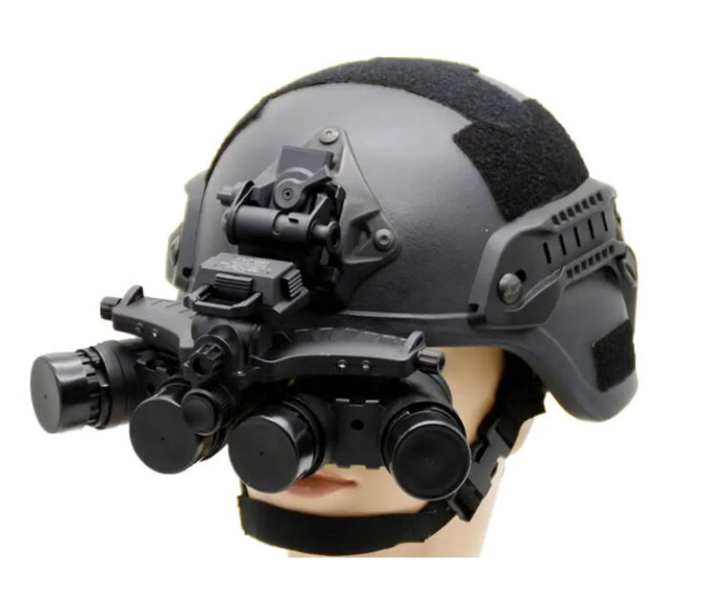
GPNVG-18 Third Generation Panoramic Head-Mounted Infrared Low-Light Quad-Eye Night Vision Device
¥250,000.00
-
Chinese yuan (¥) - CNY
-
United States dollar ($) - USD
¥250,000.00
Product Description
Technical parameters
| Optical magnification | 1X |
| Full field of view | 120×50 +/-2 degrees |
| Optical axis parallelism | <0.1 degree |
| Like an enhancer | Third generation |
| Resolution (resolution) | 72 or more LP/mm |
| Brightness gain | automatic |
| Light aperture | F1.2 25mm |
| Optical MTF | 120LP/mm |
| Optical distortion | 3% Max |
| Relative Illuminance | >75% |
| Optical coating | Ultra-wideband multilayer optical antireflective coating |
| Focusing range | 250mm-∞ |
| Focusing method | Manual |
| Eyepiece exit pupil distance | 30 |
| Eyepiece exit pupil diameter | 8mm |
| View range | +1.5 to -2.5) |
| Eye spacing adjustment method | Arbitrarily continuously adjustable |
| Eye distance adjustment range | 50-85mm |
| Eye spacing locking method | Manual Lock |
| Auxiliary light source | 850nm 20mW |
| Applicable temperature | -40–+55℃ |
| Humidity range | 5%-95% |
| Structural method | Head-mounted flip-type four-lens panoramic night vision device |
| Power supply method | Lithium-ion battery (CR123x1)/CR23x4 external battery box |
| Battery voltage range | 2.6-4.2V |
| Installation method | Headband type (standard American helmet interface) |
| Control method | ON/IR/AUTO |
| Overall power consumption | <0.2W |
| Battery capacity | 800-3200mAH |
| Battery life | 30-80H |
| Waterproof rating | IP65/IP67 |
| Product Dimensions | 155x136x83 |
| Product weight (without battery) | 880G |
Features
The NEWCOM GPNVG-18 is designed to provide users with more information in night vision environments, enabling them to navigate the OODA loop (Observe, Orient, Decide, Act) more quickly. The most significant feature of the NEWCOM GPNVG-18 is its four independent image intensifier tubes, with four independent objectives arranged in a panoramic direction. The two central lenses point forward, like traditional binocular night vision devices, giving the user greater depth perception, while the other two lenses point slightly outward from the center to increase peripheral field of view. The two tubes on the right and two on the left perform image stitching and fusion at the eyepieces. The user sees two central images overlapping with two outer images, creating an unprecedented 120° field of view. This is a game-changer for night vision equipment. The two imaging systems on each side are mounted side-by-side on a support frame and suspended from a mount similar to an ANVIS night vision helmet, providing the user with complete adjustment options. They can also be easily detached from the support frame as independent handheld night vision observation devices. The support frame assembly has a handwheel system for adjusting the interpupillary distance of the left and right eyepieces.
The NEWCOM GPNVG-18 not only has a battery mounted on the main unit, but also an auxiliary battery box connected to the main unit via a standard DC cable. It comes with a battery pack containing four 3-volt CR123A batteries, which can power the device for approximately 50-80 hours (without IR activation). The remote battery pack not only powers the main unit but also serves as a counterweight, necessary given the weight of the night vision device.
The system’s adjustment mechanism is crucial for providing the operator with the best image. A primary focus adjustment in night vision devices is diopter. Diopter focusing is traditionally achieved by rotating a diopter focusing ring. This adjusts the night vision device’s focal length, as it is related to the wearer’s individual eye. The challenge with the NEWCOM GPNVG-18’s panoramic lens assembly is that the rear lens is almost “fused” together like a prism. This results in an overlapping image from both the forward and tilt tubes for the operator. Therefore, it’s difficult to incorporate a diopter ring function into the night vision device. The original US version lacked diopter adjustment; diopter adjustment was achieved via interchangeable diopter windows on the back of the eyepiece. This kit came with various windows that clipped onto the eyepiece back housing, ranging from +0.5 to -2.5. Therefore, the operator had to ensure adjustment was performed before actual use, as field adjustments required carrying additional adjustment windows. The designers cleverly solved this problem with a special structure, allowing diopter adjustment to be freely adjustable from +1.5 to -2.5.
The NEWCOM GPNVG-18 uses the commercially available Gen3 18mmx-10160 image intensifier tube, the same one used in ANVIS night vision devices. These tubes are well-suited for maintenance due to their contact-type, solderless, replaceable design. This is a highly desirable design because the modular contact-type image tube eliminates the need for complete disassembly for replacement. Commonly used tools can be used for quick image tube replacement. In fact, the entire night vision device is designed with maintenance in mind. One of the biggest problems with night vision devices (almost any high-tech equipment) is the maintenance of damaged/malfunctioning units. This is often a lengthy process, leaving a unit temporarily without equipment because it requires specialized tools and facilities for repair. The NEWCOM GPNVG-18’s fully modular design, with its easily replaceable base and support bracket, is a significant advantage.
Using the NEWCOM GPNVG-18 is a truly unique experience, even more impressive than similar products currently available in the US. For those accustomed to the narrow field of view of standard night vision goggles, the 120-degree field of view (97-degree FOV for the US equivalent) makes nighttime seem completely different; the ultra-wide field of view is entirely unobstructed. Therefore, the image appears as clear as a traditional “zone 1” image at its widest point. There is slight occlusion in the overlapping area, but it’s very small; you only “see” the overlap of three images because your brain fuses two central areas (like any binocular system). After about 5 minutes of wearing the night vision goggles, your brain can’t even see the slight black semicircles where the overlap occurs.